
“I’ve Tried Everything”: Why ADHD Advice Often Fails Women in Midlife
It's rarely about effort. It's about the tools never fitting the brain you actually have.
“I've tried everything.”
If you've ever said those words about your own life, you're a lot less alone than it feels.
New routines. New ways of organising yourself. Another book, system or strategy that promised things would finally click if you just followed the steps properly this time.
You tried. You really did try. And somehow you're still the one apologising for being late, forgetting the thing, losing the thread by 3pm.
This isn't a post about another strategy to add to the pile. It's about what “I've tried everything” can actually be telling you, why midlife can make old ways of coping stop working, and why understanding the problem more clearly can be more useful than immediately searching for the next solution.
Key Takeaways
🔑 “I've tried everything” doesn't necessarily mean you need another strategy. Sometimes it means you need to understand the problem differently.
🔑 ADHD can make things like starting, planning, remembering, prioritising and regulating attention more difficult — which means something that looks like an organisation problem may have more going on underneath it.
🔑 Midlife can change the picture again. Hormonal changes, sleep, stress, responsibilities and changing capacity can mean ways of coping that once worked don't work as well now.
🔑 Understanding how ADHD actually shows up in your own life helps you get more specific about what support might help.
🔑 The starting point isn't “what else should I try?” It's “what's actually making this difficult for me?”
Why “I've Tried Everything” Is So Common
Most women who reach us at FAN don't arrive short of effort. They arrive exhausted by it.
Nobody is harder on themselves than a woman who's spent years quietly trying to fix something she couldn't name.
Every missed deadline, every late arrival and every dropped ball gets filed away as evidence against her — long before anyone else even notices.
And that's where the problem can become bigger than the thing she was originally struggling with.
Instead of asking “what's making this difficult?”, she starts asking “what's wrong with me?”
Those are two very different questions.
Why ADHD Can Be So Easy to Miss in Women
Part of the problem is that many women reach midlife without realising ADHD could be part of the picture.
ADHD in women doesn't always look like the stereotype many of us grew up with. Inattentive traits, masking, perfectionism and years of compensating can make struggles much less visible from the outside.
Sometimes those difficulties are understood as anxiety, depression, stress or “just hormones” instead. And for some women, it can be years before ADHD is even considered as part of the picture.
And if you don't understand what's contributing to a difficulty, it makes sense that you might spend years trying to solve it in ways that don't quite work.
Why Midlife Makes It So Much Louder
Midlife rarely asks less of you.
Hormonal changes during perimenopause and menopause may affect ADHD symptoms too, while life can be asking for more capacity at exactly the point capacity feels less predictable.
Some of the ways you've relied on to keep everything going may stop working as well as they once did.
That's often where “I used to be able to do this” creeps in.
Not because you've lost your touch. Because the maths changed, and the tools you built years ago weren't built for this version of the load.
Looking back, what strikes me most isn't how many systems I tried. It's how quickly I made their failure mean something about me.
I had a successful career. I was capable. I could hold a huge amount together. So when ordinary things felt inexplicably difficult, I didn't think, “Maybe there's a reason this is harder for me.” I thought I should be able to cope better.
Getting diagnosed with ADHD in my early fifties didn't rewrite my past. But it gave me a completely different lens through which to understand it.
What Are You Actually Trying to Solve?
This is where things can get interesting. Because the thing you're trying to fix isn't always the thing that's actually causing the difficulty.
You might think: “I need to get more organised.”
But what's actually difficult is remembering what needs doing when you can't see it.
“I need better time management.”
But the real problem might be that you've planned a day requiring twice the energy you actually have.
“I need to stop procrastinating.”
But perhaps the task has too many steps and you can't find the starting point.
“I need to be more consistent.”
But the routine only works on your good-energy days.
That's why throwing another solution at the surface problem doesn't always help.
Before choosing the support, it helps to understand the friction.

D I S C O V E R M Y P R O F I L E →
A Gentler Approach
Before you try something else, ask:
1. What exactly is difficult?
Not “my whole life is chaos.” 😂 What's the actual moment that repeatedly goes wrong?
2. What seems to make it harder?
Too many steps? Too much to remember? Low energy? Interruptions? Other people's needs? Not knowing where to start?
3. When it goes better, what's different?
Do you have more energy? A deadline? Someone alongside you? Fewer decisions? Something visible rather than hidden away?
You're not trying to fix it yet.
You're gathering clues.
Because once you understand what's creating the friction, you're in a much better position to experiment with something that might actually help.
Final Thoughts
I'm not going to pretend understanding your ADHD brain fixes everything overnight. It doesn't.
But it can change the question you're asking yourself.
From: “Why can't I just get this right?”
to: “What's actually making this difficult — and what might help?”
That's a kinder question.
It's also a far more useful one.
So if you've found yourself saying “I've tried everything”, perhaps the next step isn't trying harder — or immediately trying something else.
Perhaps it's understanding the problem differently first.
What's one everyday thing that seems to take far more effort than it should?
Clare 💫
A gentle note: this post combines personal experience with general information about ADHD in midlife. It isn’t intended to diagnose or replace professional medical advice. If any of this resonates with you, a conversation with your GP could be a helpful first step.
Want More Support?
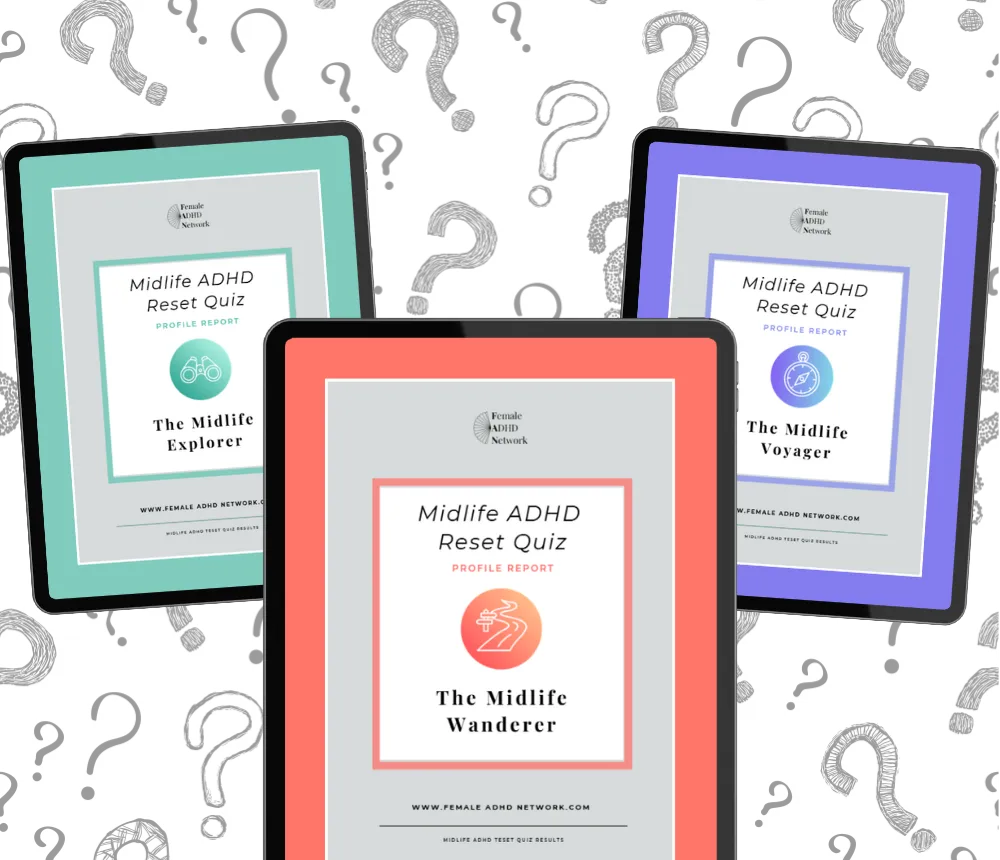
If you're not sure where to start, the free Midlife ADHD Profile Discovery Quiz helps you explore where you are in your midlife ADHD journey and what could be most useful to focus on right now.
It takes around five minutes, and you'll receive your Midlife ADHD Profile plus three ADHD-friendly first steps tailored to your result.
Take the free Midlife ADHD Profile Discovery Quiz → Take the quiz
Not sure where you’re starting from? The free MAP Quiz shows you your profile, Wanderer, Explorer or Voyager, in under 5 minutes.